



Use a dedicated bike GPS?
With technological advances and the widespread adoption of navigation apps, many cyclists are wondering whether it's still relevant to use a dedicated bike GPS.
Can a smartphone really replace it?
In this article, we compare both options based on use cases, without bias, to help you make the right choice for your riding style.
GPS navigation by bike
Accuracy and reliability
A dedicated bike GPS typically uses GPS, GLONASS or Galileo satellites to deliver high accuracy, even in remote areas. Smartphones rely on the same satellite networks but sometimes depend on mobile network connectivity for certain apps.
Under good conditions, accuracy remains comparable, although GPS remains more consistent off-network.


Bike screens: dedicated vs smartphone
Display and readability
The GPS has a screen designed for outdoor use, often anti-glare and very readable in direct sunlight.
The smartphone, being larger, can display more details, but its readability depends on brightness and screen quality. Moreover, some apps require a connection to display the map, unlike GPS devices that often include built-in maps.


Which one lasts longer?
Battery life and management
One of the major advantages of bike GPS devices is their battery life: between 10 and 30 hours depending on the model. Smartphones, with constant GPS use and the screen on, consume more power.
However, adding an external battery or using a power-saving mode can extend their usage time, especially for medium to long rides.


Bike mount and bike GPS
Mounting and use
Bike GPS devices are designed to fit standard mounts, with a stable and secure installation.
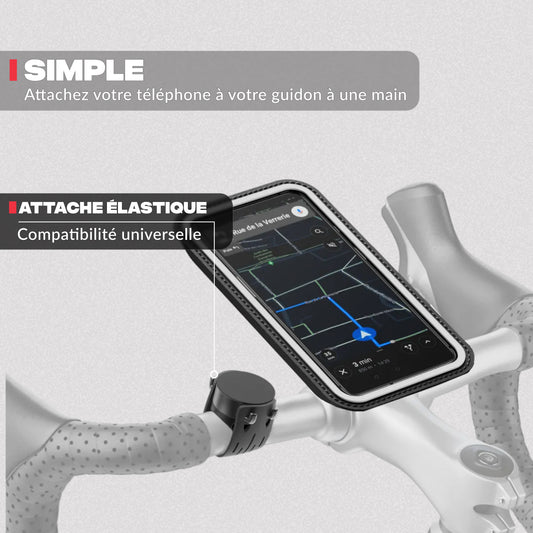
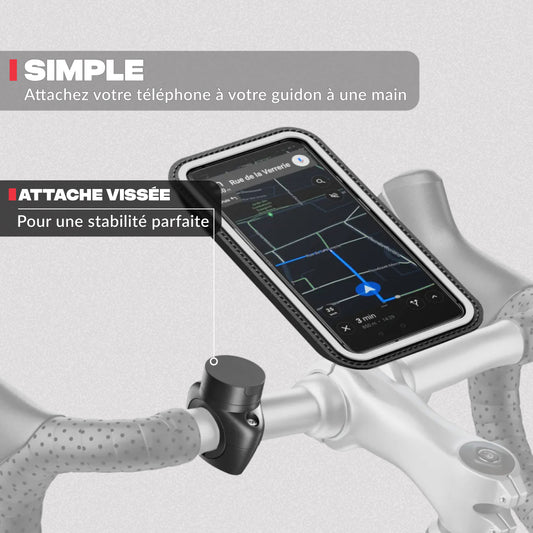
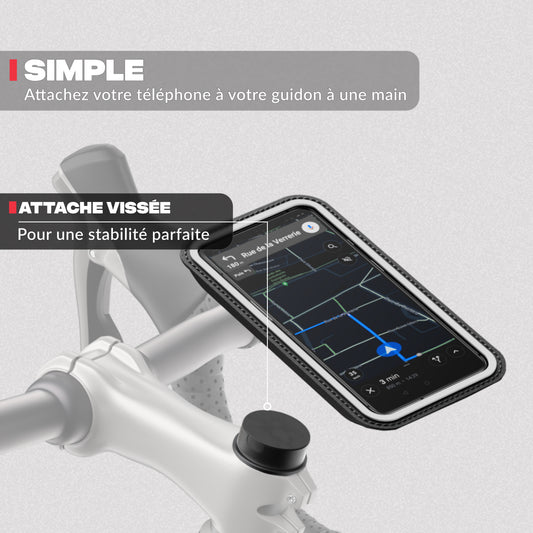
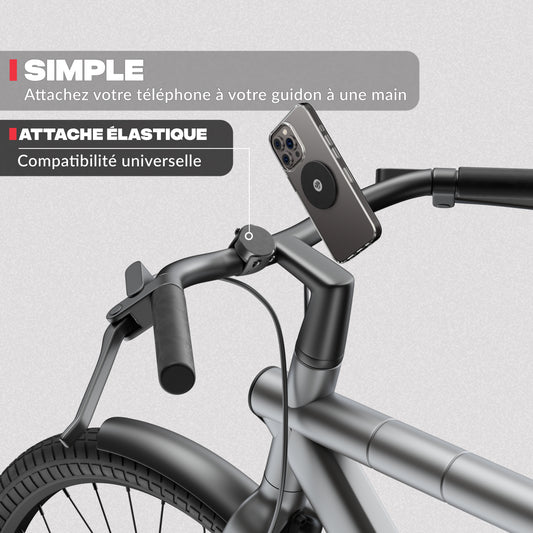
For smartphones, it all depends on the mount used. Shapeheart offers magnetic bike mounts, making it easy to attach and detach your phone, even with gloves on. This type of accessory lets you access navigation while keeping your hands on the handlebars and your eyes on the road, while ensuring good stability.


Discover our bike range!
-
Bike phone holder
Regular price €29,95 EURRegular priceUnit price per -
PRO bike phone mount
Regular price €39,95 EURRegular priceUnit price per -
Bike stem phone mount
Regular price €39,95 EURRegular priceUnit price per -
Bike phone mount
Regular price €29,95 EURRegular priceUnit price per




What investment for your cycling use?
Cost and versatility
A GPS represents an initial investment often exceeding €200, but is dedicated solely to cycling. On the other hand, a smartphone is already owned by the majority of cyclists and can be used for much more than navigation.
However, it requires a good mount, protection against the elements, and sometimes an external power source for long rides.


The key is to choose the tool that suits your needs, making sure you have a good mount and a reliable attachment to ensure comfort and safety.
And you, what tool do you use on your bike rides? Let us know in the comments.
Also worth reading: The essential bike accessory for smoother urban mobility.
Want to discover our latest articles....
View all-

iPhone 18 Pro: the best motorcycle mount
The iPhone 18 Pro (150.0 mm height) is compatible with the Shapeheart magnetic Sleeve in XL variant. Complete guide: dimensions, compatibility with or without case, and recommendation of the Moto...
iPhone 18 Pro: the best motorcycle mount
The iPhone 18 Pro (150.0 mm height) is compatible with the Shapeheart magnetic Sleeve in XL variant. Complete guide: dimensions, compatibility with or without case, and recommendation of the Moto...
-

iPhone 18: which motorcycle mount to choose?
Compatibility guide for motorcyclists who just purchased an iPhone 18 Pro or 18 Pro Max. Official dimensions, Shapeheart Sleeve size suited to each model, and recommendation of the Moto PRO...
iPhone 18: which motorcycle mount to choose?
Compatibility guide for motorcyclists who just purchased an iPhone 18 Pro or 18 Pro Max. Official dimensions, Shapeheart Sleeve size suited to each model, and recommendation of the Moto PRO...
-

Google Pixel 11: which motorcycle mount to choose?
The Google Pixel 11 is compatible with all Shapeheart magnetic Sleeves, with no additional accessories. However, its sophisticated OIS is sensitive to engine vibrations. This guide compares the Moto PRO...
Google Pixel 11: which motorcycle mount to choose?
The Google Pixel 11 is compatible with all Shapeheart magnetic Sleeves, with no additional accessories. However, its sophisticated OIS is sensitive to engine vibrations. This guide compares the Moto PRO...


