



Motorcycle road trip: navigate without draining your battery
A motorcycle road trip of 400 to 600 kilometers is a beautiful day on the road. It's also four to six hours of active GPS navigation, screen constantly on, and data connection running without interruption. Classic result: halfway through, the battery is below 20%, and you're looking for an electrical outlet rather than a nice turn. Two problems account for most damage over long distance: accelerated power consumption and engine vibrations that threaten the camera. A well-chosen mount reduces both.
- GPS navigation with screen on can consume 15 to 20% of battery per hour in intensive use.
- Apple recommends an operating range of 0 to 35 °C for iPhones (Apple Support).
- High-power engine vibrations can damage camera OIS, according to Apple (Apple Support).
- Correct screen orientation prevents glare and reduces automatic brightness, thus consumption.
- The anti vibration module is essential for any long-term motorcycle mount.
Why does the battery drain on the road?
GPS navigation simultaneously engages the processor, GPS module, mobile data connection, and screen. This combination can consume 15 to 20% of battery per hour. In high heat, degradation accelerates: Apple specifies that iPhones are designed to operate between 0 and 35 °C (Apple Support). Beyond this threshold, the device automatically reduces performance to protect the battery.
On the highway in summer, a smartphone mounted on the handlebar in full sun quickly exceeds this limit. iOS or Android then activates thermal protection: the processor slows down, the map freezes, recalculations pile up. Your battery life drops even faster, exactly when you need it most.
Three reflexes mitigate the impact before leaving: download maps in offline mode to cut data consumption, enable battery saver mode, and orient the screen to reduce automatic brightness. This last point depends entirely on your mount.
Glare and brightness: the vicious circle
A poorly oriented screen triggers automatic brightness adjustment. Result: 100% backlighting for the entire trip. Yet maximum brightness is one of the highest power consumption items, ahead of GPS itself. Over five hours on the road, reducing brightness from 100% to 40% can represent up to an extra hour of battery life.
The problem often comes from the mount itself: a fixed-angle model doesn't allow you to correct orientation based on sun position. In the morning, you're heading east. In the afternoon, due west. The optimal angle changes every hour, and a fixed mount doesn't adapt to it.
The PRO BOOST, 360° extension arm
The PRO BOOST motorcycle mount features a 360° extension arm that lets you reposition the screen in seconds, even while riding. The magnetic Phone Sleeve keeps your phone firmly in place, tool-free, on all standard handlebar types. It's the best-selling model in the motorcycle range. Price: $49.95.

"A well-oriented screen means less glare, less automatic brightness, and a battery that lasts until the evening stop."
Correct orientation also reduces eye strain over long distance. You read the map more easily, you interact less with the device to recalculate or zoom. Fewer interactions means less processor load, and these small gains add up over a full day on the road.
Engine vibrations: danger for OIS?
Apple is explicit on this point: high-amplitude vibrations generated by motorcycle engines, particularly sport bikes and adventure bikes, can damage the camera's optical image stabilization system (Apple Support). OIS is a mechanical component made up of small mobile lenses held in place by magnets. Prolonged exposure shifts these elements and permanently degrades image quality.
This risk is particularly present with rigid mounts, where vibrations are fully transmitted from the handlebar to the phone. Over a full-day road trip, cumulative exposure represents several hours of repeated micro-shocks. The longer the trip, the more the risks to your camera accumulate.
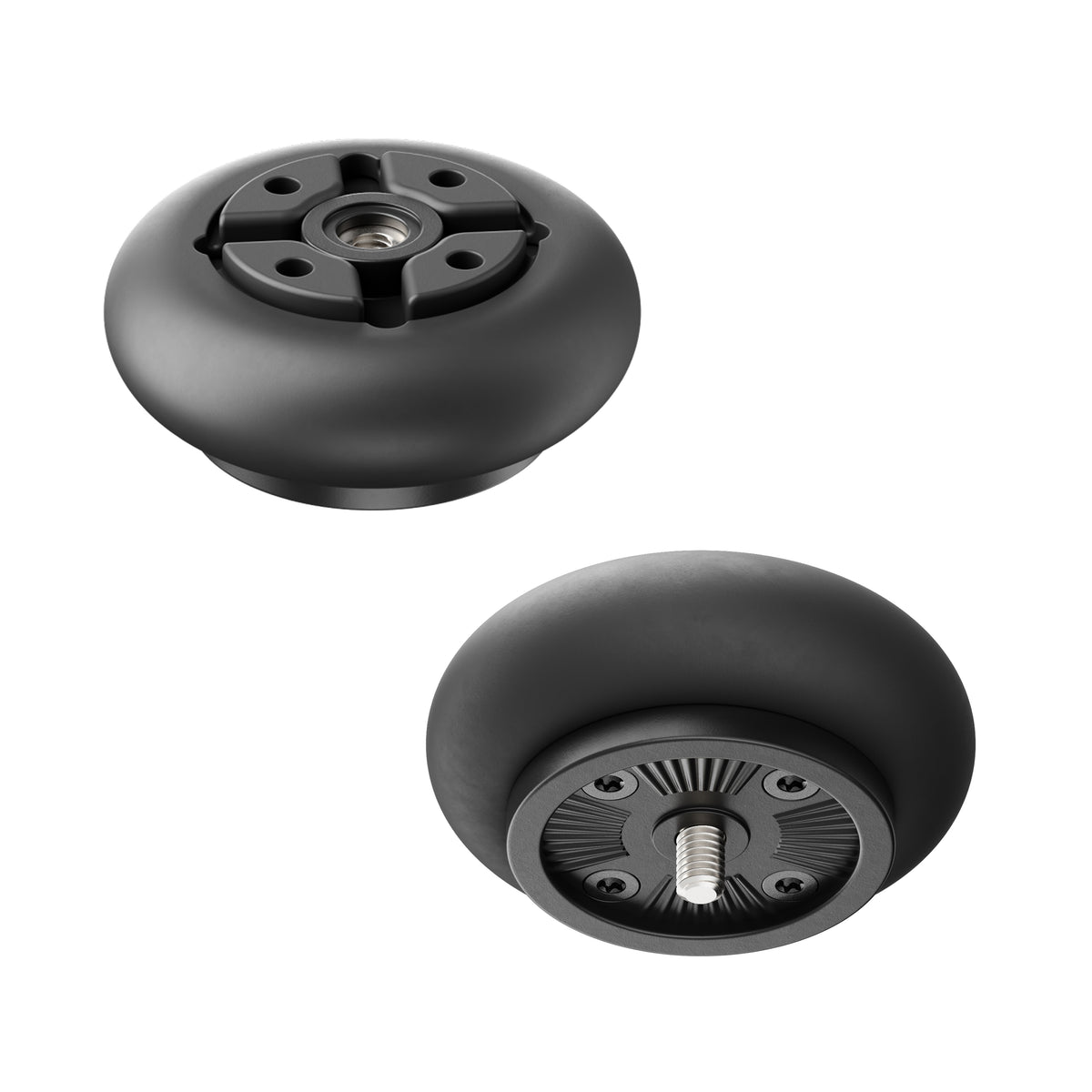
The anti vibration module: essential for long distance
The Shapeheart anti vibration module sits between the mount and the handlebar. It absorbs frequencies harmful to OIS without compromising phone stability on the road. Recommended for any trip over 30 minutes on a motorcycle with an internal combustion engine. Price: $14.95.
This risk also affects Android devices. Apple is the most explicit brand in its documentation, but any smartphone equipped with a mechanical optical stabilizer faces the same physical phenomenon. The solution is the same: place a dampener between the handlebar and the mount.
Which mount for your motorcycle?
The choice depends on handlebar type. On a standard roadster, adventure, or cruiser handlebar, the PRO BOOST adapts to all common diameters and remains the reference in the range. On a sport bike with clip-on handlebars, the MINI BOOST is specifically sized for this narrower handlebar profile.
In both cases, the magnetic Phone Sleeve allows placement or removal in less than 2 seconds. No clip to open, no screws to loosen. You place the phone when leaving the parking lot, you remove it when arriving at your destination. Even with motorcycle gloves, the operation stays just as simple.
For long-distance road trips, the anti vibration module is the add-on to plan for from the start. It installs once, between the mount and the handlebar, and works silently to protect your camera. It's a $14.95 investment that protects a camera whose replacement can cost several hundred dollars in out-of-warranty repair.
An extra precaution on heavily damaged roads or mountain passes: the phone leash. This tether connects your smartphone to your wrist or to the motorcycle and limits the consequences of accidental detachment. A lightweight additional safety measure, easy to slip into your saddlebag before leaving.
Frequently asked questions
Can you charge your phone while riding without damaging the battery?
Yes, as long as you use a USB charger calibrated for your motorcycle's voltage and don't charge in high heat. Apple advises against intensive use during charging at temperatures above 35 °C (Apple Support). Provide good ventilation around the phone and avoid charging at rest in hot summer sun.
Is the anti vibration module compatible with the PRO BOOST?
Yes. The anti vibration module is designed to integrate with the PRO BOOST and other mounts in the motorcycle range with handlebar mounting. It installs in seconds with no tools. On a road trip, it's the recommended combination: the PRO BOOST for screen orientation, the module for camera protection.
How do you reduce GPS consumption over long distance?
Download offline maps before you leave: this eliminates mobile data consumption during navigation. Then activate battery saver mode and reduce brightness with an adjustable mount. These two adjustments combined allow significant battery life gains over a full day on the road.
Do motorcycle vibrations also damage Android devices?
Apple is the most explicit brand on this risk, with a dedicated page on motorcycle vibrations and OIS (Apple Support). Android devices equipped with an optical stabilizer face the same physical phenomenon. The anti vibration module effectively protects all models, regardless of ecosystem.
Products from this article
One magnet, all your mounts — attach and detach with one hand.


Ride, run, pedal — stay connected
One magnet, all your mounts — attach and detach with one hand.
Discover Shapeheart mounts